
Read this first
This article is general information to help owners, builders, and site managers understand how vegetation and hydroseeding relate to stormwater closeout in Texas. It is not legal advice and does not replace the text of your permit, your stormwater pollution prevention plan, or your contract documents. Requirements depend on which permit authorizes your discharges, the version in effect for your coverage, local ordinances, and the specifications in your contract. When in doubt, read the official documents linked at the end and consult the person responsible for your SWPPP.
The permit behind most Texas construction SWPPPs
In Texas, stormwater discharges from regulated construction activity are generally authorized by the Texas Commission on Environmental Quality under TPDES General Permit TXR150000, commonly called the Construction General Permit or CGP. TCEQ provides a page titled Stormwater Discharges from Construction Activities: Am I Regulated? that walks through whether a project needs coverage, based on factors such as the area disturbed and whether it is part of a larger common plan of development.
The CGP is reissued periodically. TCEQ's fact sheet for the 2023 CGP describes the renewal of the prior permit, which was issued in 2018. Earlier versions also exist, and older permit documents still circulate online. The definition and conditions that apply to your project are those in the permit version under which you hold coverage, so confirm which document you are working from before relying on any specific language, including anything quoted in articles like this one.
What final stabilization generally means
Under the CGP, final stabilization is one of the conditions that allows an operator to end permit coverage, typically by submitting a Notice of Termination for larger sites or following the applicable procedure for smaller sites. In broad terms, final stabilization means that soil-disturbing activities are complete and the disturbed areas are covered either by permanent vegetation or by equivalent permanent stabilization measures, such as riprap, pavement, or geotextiles.
The 2023 Texas CGP defines one route to final stabilization as completion of all soil-disturbing activities and uniform perennial vegetative cover with a density of at least 70 percent of native background cover on unpaved areas not covered by permanent structures. Uniform means evenly distributed, without large bare areas. Equivalent permanent measures, such as riprap or gabions, are another option. This is not simply 70 percent of a construction lot being green. The definition also contains separate conditions for individual residential lots, agricultural land and arid areas; read the applicable condition rather than applying the vegetative criterion universally.
Why you should not repeat a universal 70 percent rule
It is common to hear that stabilization means 70 percent grass coverage, period. That shortcut omits the reference to native background cover, the need for a uniform perennial stand and the requirement to complete soil-disturbing work. A few green strips do not necessarily meet the definition. The 2023 permit also addresses residential-lot transfers, agricultural land and arid areas separately. Confirm which condition applies and which evidence your operator needs. Your contract may require a denser stand or a different completion standard than the permit definition.
Contract requirements are a separate layer
The CGP sets what the permit requires. Your construction contract, plans, and specifications can set additional, stricter, or more specific requirements for vegetation, and those are what determine whether the owner or engineer accepts the work. Public agencies, municipal utility districts, drainage districts, and private owners often write their own seeding specifications that state seed mixes, rates, mulch types, watering responsibilities, coverage percentages, inspection methods, and timing.
In practice, this means a project can satisfy the permit's vegetative standard and still not meet a contract acceptance criterion, or the reverse. Treat the two as separate checklists.
- Permit: which TXR150000 version applies, what final stabilization requires under it, and what must be documented before termination.
- SWPPP: the site-specific plan describing stabilization practices, schedules, and responsibilities.
- Contract: seed mix, rates, mulch, coverage measurement, establishment period, maintenance, and acceptance procedures.
- Local rules: city or county drainage and erosion control criteria that may apply in addition to state requirements.
Temporary versus permanent stabilization
The CGP also addresses stabilization during construction, not only at the end. When work stops in an area for a period, the permit and SWPPP typically require stabilization measures to begin within a set timeframe. Hydromulch, temporary seeding, and erosion control blankets are commonly used for this purpose.
Temporary stabilization protects soil now. Final stabilization is about the end state. A quick-germinating annual cover crop sprayed in the cool season may protect soil through winter, but it may not count toward perennial cover at closeout. Planning the sequence, temporary cover now and permanent seeding when the season allows, avoids paying twice.
Where hydroseeding helps
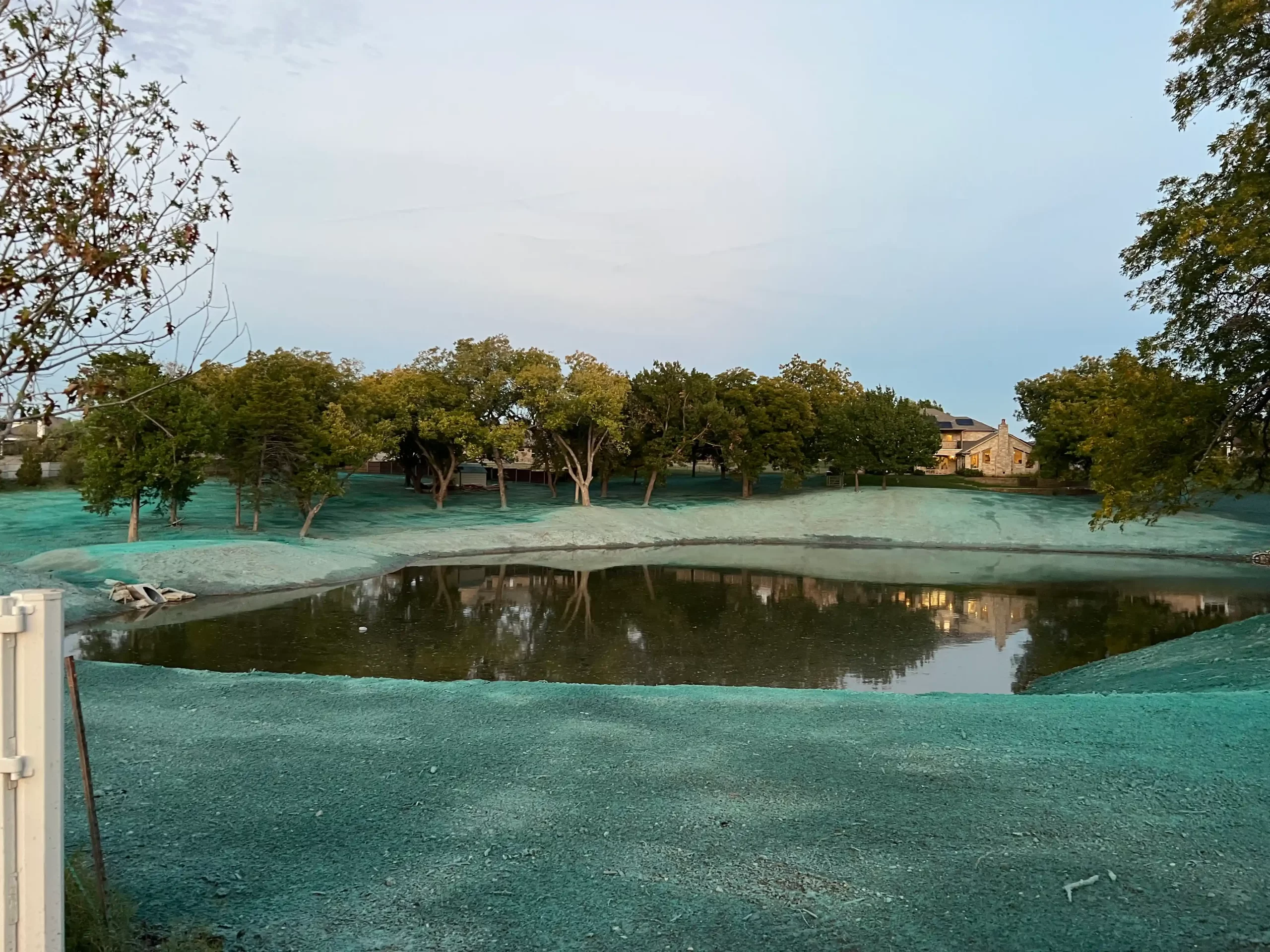
Hydroseeding is well suited to stabilization work because it applies seed, mulch, fertilizer, and tackifier in one pass over large or irregular areas, including slopes, detention ponds, swales, and rights-of-way that are difficult to reach with sod. The mulch layer provides immediate surface protection while seed germinates.
- Detention and retention pond slopes, where erosion and sediment control are critical.
- Roadside shoulders and utility corridors with long linear runs.
- Large graded pads waiting on later phases.
- Individual lots in subdivisions approaching closeout.
- Repair of washed-out areas identified during inspections.
Planning seeding that reaches closeout
Final stabilization is judged on established perennial vegetation, not on the day of application. Fresh hydromulch looks uniformly green because of the dye in the mulch, but that color is not grass. Plan for the time it takes seed to germinate and fill in.
Match species to season and use
Warm-season perennial grasses, such as bermudagrass, establish when soils are warm. Texas A&M AgriLife Extension's turfgrass selection guidance is a good starting point for species adaptation. Seeding a warm-season perennial in cold months often means waiting until spring for meaningful growth, so a temporary cover plus a later permanent seeding may be the realistic plan.
Prepare the soil
Compacted subgrade, debris, and poor topsoil are common reasons stabilization stalls. Loosen compacted areas, remove debris, and grade so water does not pond on or wash across the seeded surface.
Choose mulch for the slope and flow
Steeper slopes and areas with concentrated flow need heavier mulch rates, bonded fiber matrix products, or blankets. Matching protection to erosion risk reduces the number of repair applications.
Water and maintain
Rainfall in the Houston area is irregular. Clarify in the contract who is responsible for watering during establishment and whether it is required. Inspect after storms and repair thin or eroded spots promptly.
Documentation
Termination of coverage depends on records as well as conditions on the ground. Keep dated photographs of seeded areas from consistent locations, along with inspection reports and notes about repairs and re-seeding. TCEQ's SWPPP template, publication RG-639, offers a structured format for recording stabilization practices and schedules. Whoever signs the Notice of Termination is certifying that the conditions for termination are met, so the evidence should be organized well before that date.
Common reasons closeout gets delayed
Projects rarely miss stabilization because nobody seeded. More often, the seeding was done but did not establish in time, or it established unevenly and left gaps that an inspector or owner will not accept. Typical causes include seeding a warm-season perennial late in the fall, spraying onto compacted subgrade, washouts on slopes protected only by light mulch, vehicle traffic across seeded lots during final construction, and lack of water during a dry stretch. Each of these can be anticipated in the schedule. Building in time for a repair application after the first significant storm is a simple way to protect a closeout date.
Questions to settle before the first spray
A short conversation at the start can prevent a long delay at the end. Before seeding, confirm the following with the owner, engineer, or SWPPP administrator:
- Which CGP version the project's coverage falls under.
- Whether the contract states its own coverage percentage or acceptance method.
- Any required seed mix, application rates, and mulch products.
- Who handles watering, mowing, and repairs during establishment.
- The target closeout date and whether the season supports permanent seeding by then.
Summary
Final stabilization in Texas is defined by the permit you are covered under and supplemented by your contract and local requirements. The vegetative standard commonly cited is relative to native background cover, comes with alternatives, and varies by permit text. Hydroseeding is an effective tool to reach it when seeding is timed, prepared, and maintained with closeout in mind. If you are working toward a stabilization deadline, share your plans, specifications, and schedule through our contact page and we can discuss an application plan.
Sources and further reading
- TCEQ: Stormwater Discharges from Construction Activities, Am I Regulated?
- TCEQ: 2023 Construction General Permit Fact Sheet (PDF)
- TCEQ: 2023 Construction General Permit TXR150000
- TCEQ RG-639: SWPPP Template for the Construction General Permit (PDF)
- Texas A&M AgriLife Extension: Turfgrass Selection for Texas (PDF)
This article is general information. Always confirm requirements against the current official documents that apply to your project.
Planning a project?
Explore our services or send site details for a free, site-specific quote.