
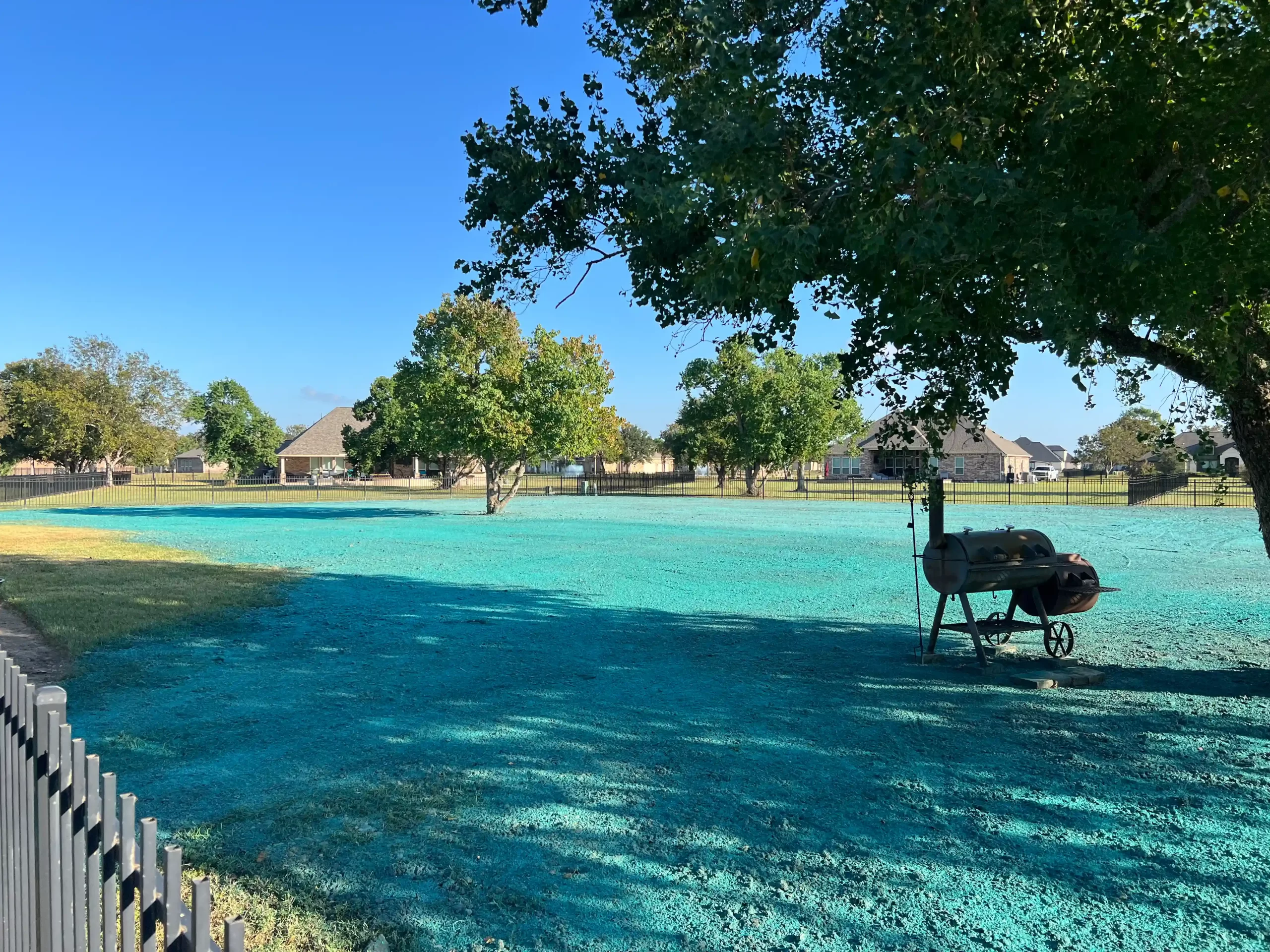
Why there is no single honest per-square-foot number
Property owners often ask for a price per square foot before anyone has looked at the site. It is a fair question, because square footage is the easiest thing to measure. The trouble is that the area is only one of several variables, and on many Houston projects it is not the one that moves the total the most. Two lots of identical size can produce very different quotes because one is a bare, graded pad with a hose bib ten feet away and the other is a compacted clay slope behind a fence with debris, ruts, and no water access.
This article does not publish our prices, and it does not claim to describe current market rates. Prices for seed, fertilizer, fiber mulch, tackifier, fuel, and labor change, and any figure printed online goes stale. Instead, we explain what goes into a hydroseeding quote and show simple, clearly labeled arithmetic so you can understand how a per-square-foot figure is built and how to compare two bids fairly.
What you are actually paying for
A hydroseeding application is a mix of seed, mulch, water, and usually fertilizer and a tackifier, sprayed through a hydroseeder onto prepared soil. The material cost scales with area, but several parts of the job do not scale neatly.
- Mobilization: getting the truck, hydroseeder, and crew to the site costs roughly the same whether the area is small or large.
- Site preparation: clearing debris, fine grading, loosening compacted soil, or bringing in topsoil can exceed the cost of the spray itself.
- Seed selection: species, blend, and seeding rate change the material cost per thousand square feet.
- Mulch type and rate: wood fiber, paper blends, and bonded fiber matrix products differ in cost and in how much erosion protection they provide on slopes.
- Access and hose length: long hose runs, gates, fences, and tight side yards slow the crew down.
- Water source: whether water is available on site or must be hauled affects time on every tank load.
- Follow-up: a second application, spot repairs, or touch-up after a storm may or may not be included.
How minimums distort small-job pricing
Because mobilization and setup are largely fixed, small projects almost always show a higher cost per square foot than large ones. A contractor has to load material, drive across the metro, set up, spray, clean out the equipment, and drive back regardless of whether the job is a narrow side yard or a full acre. Many contractors handle this with a job minimum rather than a strict per-square-foot rate.
If you compare a small residential quote with a per-square-foot figure you saw for a large commercial site, the residential number will look high. That is not necessarily a sign of overcharging. It is the fixed costs being spread across fewer square feet.
Illustrative example: fixed cost spread over area
The numbers below are invented for arithmetic only. They are not our prices and are not intended to represent current Houston market rates. Suppose a hypothetical job has a fixed setup cost of A dollars and a variable material and labor cost of B dollars per thousand square feet. If A were 400 and B were 100, a 2,000 square foot job would total 400 plus 200, or 600 dollars, which works out to 30 cents per square foot. A 20,000 square foot job under the same assumptions would total 400 plus 2,000, or 2,400 dollars, which works out to 12 cents per square foot.
Nothing about the material changed between those two examples. The per-square-foot figure dropped because the fixed portion was divided among ten times as much area. Keep this pattern in mind whenever someone quotes a single number without asking about your site.
Site preparation is often the biggest swing factor
Hydroseed is not a fix for poor soil preparation. Seed needs good contact with loose soil, and the slurry should be sprayed onto a surface that has been graded to drain. In the Houston area, new construction lots frequently have compacted subsoil, construction debris, tire ruts, concrete washout, and patches of exposed clay. Each of those conditions has to be addressed before spraying if you want even germination.
When comparing quotes, look for a clear statement of what preparation is included. One bid might assume the site is already fine graded and ready to spray. Another might include removing debris, tilling or scarifying compacted areas, and smoothing ruts. The second bid will cost more, but it may be the only one that leads to a uniform lawn.
- Ask whether the quote includes debris removal, and what counts as debris.
- Ask whether compacted areas will be loosened and how.
- Ask whether topsoil is included or assumed to be present.
- Ask whether the price assumes the general contractor has completed final grade.
Seed and mulch choices change the material line
Seed cost varies by species and by seeding rate. Texas A&M AgriLife Extension notes in its turfgrass selection publication that some warm-season grasses, including many bermudagrass varieties, are available as seed, while St. Augustinegrass is typically established from sod, sprigs, or plugs rather than seed. That matters for cost because it determines whether hydroseeding is even the right method for the grass you want.
Mulch is the other major material. A light wood or paper fiber mulch on a flat lawn is a very different product from a heavier bonded fiber matrix sprayed on a steep detention pond slope. The heavier products cost more per unit area and are applied at higher rates, but they hold soil and seed in place under conditions where a light mulch would wash out. If two bids specify different mulch products or rates, they are not quoting the same job.
Access, water, and logistics
Hydroseeding equipment needs water for every tank of slurry. When a site has a usable water source nearby, the crew can refill and keep spraying. When water must be hauled, every refill adds time. Access matters just as much. A truck parked at the curb with a short hose run is efficient. A backyard reached through a narrow gate, with a pool, fences, and finished landscaping to protect, takes longer and requires more care.
Commercial and public projects bring their own logistics: traffic control near roads, coordination with other trades, safety requirements, and documentation. Those items appear in a quote even when the square footage looks modest.
What happens after the spray
The most expensive hydroseeding job is the one that has to be redone. Germination and establishment depend on watering, temperature, rainfall, and protection from traffic. A quote should be clear about what the contractor does after application and what the owner is responsible for. Some bids include a return visit or a spot re-seed; others do not. Neither is wrong, but you should know which one you are buying.
Read any written guarantee carefully rather than assuming one exists. Establishment depends on factors outside the contractor's control, such as watering, drought, flooding, and foot or vehicle traffic, so terms vary widely between companies and projects.
A worked comparison of two hypothetical bids
Imagine you receive two bids for the same 8,000 square foot area. These are invented figures for illustration only. Bid one lists a total that works out to 10 cents per square foot and states that the site must be fine graded and debris free before arrival, with light fiber mulch and no follow-up visit. Bid two works out to 16 cents per square foot and includes debris removal, scarifying compacted areas, a heavier mulch rate on the sloped portion, and one touch-up visit.
At first glance bid one is cheaper by 6 cents per square foot, or 480 dollars across 8,000 square feet. But if your site is not actually fine graded, you will either pay someone else to prepare it or accept uneven results. The useful question is not which number is lower, but which bid describes the work your site needs.
Information that gets you an accurate quote faster
The more a contractor knows about your site, the less guesswork goes into the price. When requesting a quote, share the details below. Photos taken from several angles are especially helpful.
- Property address or nearest cross streets.
- Approximate area in square feet or acres, or a site plan.
- Current condition: bare soil, weeds, old turf, construction debris.
- Slopes, ditches, detention ponds, or drainage channels in the work area.
- Water availability on site.
- Whether the work is residential, commercial, or tied to a stormwater permit or contract specification.
- Your timeline and any inspection or closeout dates.
The bottom line
A per-square-foot figure is a useful way to compare bids only after you confirm that the bids describe the same scope. Area, preparation, seed, mulch, access, water, and follow-up all shape the total, and fixed costs make small jobs look more expensive per square foot. Use the illustrative math above to understand the structure of a quote, then ask for a site-specific estimate. If you would like one, send us your project details and photos through our contact page and we will review your site before talking numbers.
Sources and further reading
- Texas A&M AgriLife Extension: Turfgrass Selection for Texas (PDF)
- Texas A&M AggieTurf: Bermudagrass fact sheet (PDF)
- Texas A&M AgriLife Soil, Water and Forage Testing Laboratory
This article is general information. Always confirm requirements against the current official documents that apply to your project.
Planning a project?
Explore our services or send site details for a free, site-specific quote.