
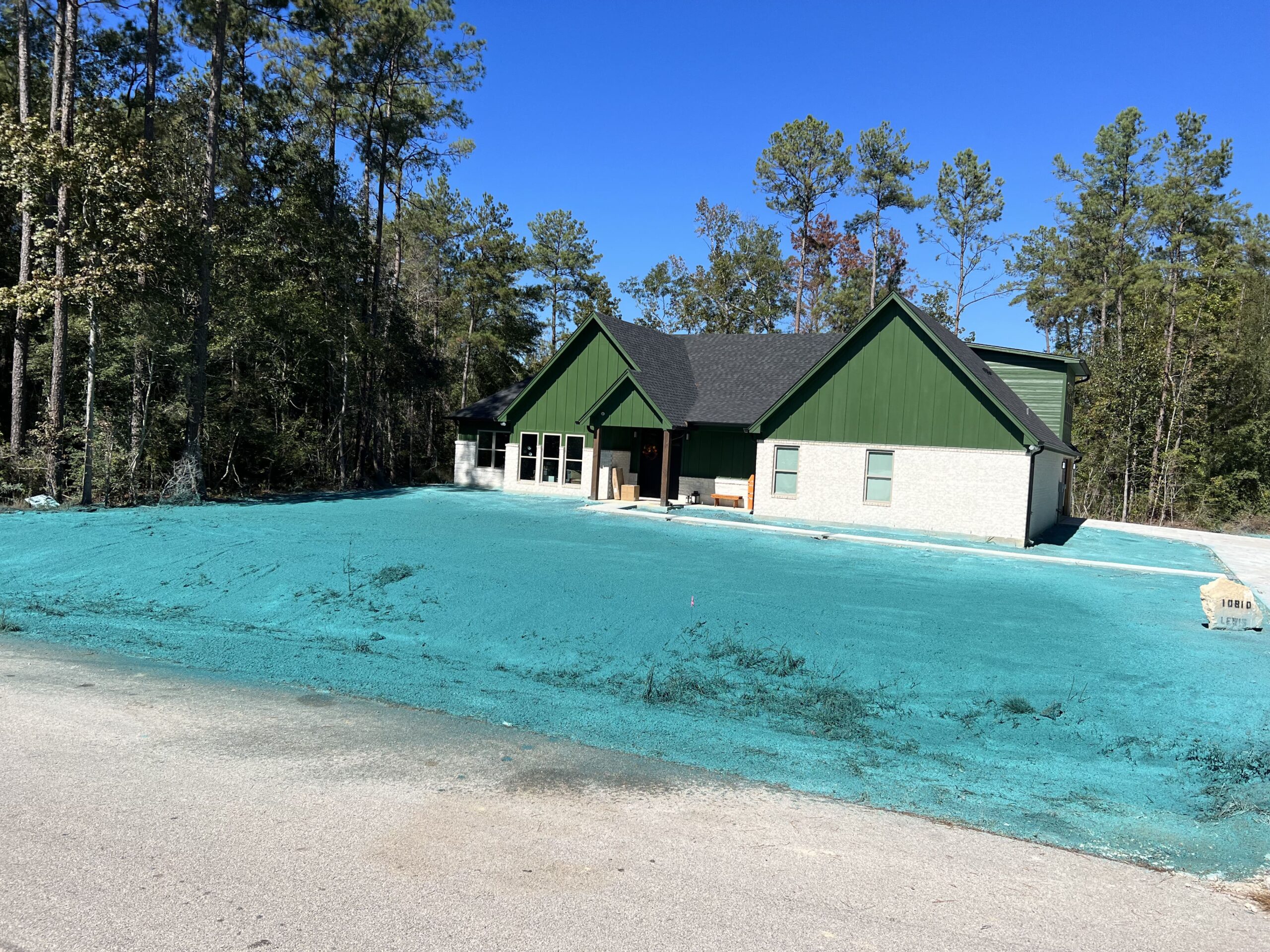
What people mean by gumbo
Ask anyone who has dug a post hole in much of Harris County and the surrounding area and they will describe the same soil: dark, dense, slick when wet, and rock hard when dry. Locally it is called gumbo. The nickname is informal rather than a scientific soil name, but it describes a real set of behaviors that come from a high clay content.
Soil conditions change from one neighborhood to the next, and some parts of the region have sandier or loamier soils. Before assuming you have gumbo, you can look up the mapped soils for your address using the USDA Natural Resources Conservation Service Web Soil Survey, which reports properties such as texture and drainage class for mapped soil units. Pair that with a soil test, and you will know far more than a visual guess can tell you.
How heavy clay affects new seed
Clay particles are very small and pack tightly. That gives clay soils a high capacity to hold water and nutrients, which is helpful, but it also creates problems for a newly seeded area.
- Slow infiltration: rain and irrigation can sit on the surface or run off before soaking in, which can wash seed and mulch downhill.
- Crusting: a bare clay surface can seal over after rain and dry into a crust that young seedlings struggle to push through.
- Shrinking and swelling: many clays expand when wet and crack when dry. Surface cracks can dry out seed and roots quickly.
- Compaction: construction traffic presses clay into a dense layer that roots and water have difficulty penetrating.
- Poor drainage in low spots: standing water in depressions can drown or rot seed and young grass.
Start with a soil test, not a guess
The Texas A&M AgriLife Extension Soil, Water and Forage Testing Laboratory offers soil analysis for homeowners, landscapers, and producers. A routine test reports pH and nutrient levels and comes with recommendations. On heavy clay, a test helps you avoid two common mistakes: adding amendments the soil does not need, and missing a nutrient shortage that slows establishment.
Collect samples from several spots across the area to be seeded and follow the laboratory's sampling instructions. If the site includes distinctly different zones, such as a cut slope and an untouched front yard, sample them separately. Local county Extension offices, including Harris and Fort Bend counties, can explain how to submit samples.
Deal with compaction before you spray
Hydroseed works best when seed lands on a loose, slightly roughened surface where it can settle into small crevices and make contact with soil. On a compacted construction pad, seed tends to sit on top of a hard surface where it dries out or washes off.
Breaking up the top few inches with a tiller, ripper, or scarifier helps. The goal is not to turn the soil into powder, which can crust badly, but to create a crumbly, uneven surface. Work clay only when it is moist but not wet. Tilling saturated clay smears and seals it, creating larger, harder clods once it dries. A simple field check is to squeeze a handful: if it ribbons out and stays sticky, wait.
Should you add topsoil or compost?
Adding a layer of quality topsoil or incorporating organic matter can improve the surface where seed germinates. The key word is incorporate. A thin layer of sandy fill dumped on top of compacted clay can create a sharp boundary that holds water at the interface and limits root growth. If you add material, mix it into the loosened clay surface rather than simply spreading it on top. Base decisions on your soil test and site conditions rather than on a blanket rule.
Grade for drainage first
Water management matters more on clay than almost anywhere else. Before seeding, make sure the finished grade moves water away from structures and toward swales, inlets, or ditches, and fill low spots where water ponds. In Houston's heavy rain events, even a shallow depression can hold water long enough to damage a new seeding.
On slopes, consider the erosion risk before choosing the mulch. Rain that cannot soak into clay runs downhill, carrying loose seed with it. A heavier mulch rate or a bonded fiber matrix product gives more protection on slopes and channel banks than a light lawn mulch. Erosion control blankets may be appropriate in concentrated flow areas where sprayed mulch alone is not enough.
Timing the application
Warm-season grasses commonly used in the Houston area germinate and grow when soil temperatures are warm. Texas A&M AgriLife Extension's turfgrass guidance describes warm-season species such as bermudagrass as growing actively in warm months and going dormant after frost. Seeding warm-season grass in the middle of winter means seed sits in cold, wet clay for weeks.
For permanent warm-season turf, spring through late summer is generally the productive window, adjusted for irrigation availability and the forecast. When soil must be covered outside that window, for example to stabilize a construction site, a temporary cover crop or mulch-only application can protect the soil until conditions allow a permanent seeding. Your seed supplier and the Extension resources linked below can help match species to the season.
Watering clay without drowning the seed
Clay absorbs water slowly, so long irrigation runs often produce runoff and puddles instead of deeper moisture. During germination, the goal is to keep the seed zone consistently moist, not saturated. Shorter, more frequent cycles usually work better than one long cycle on clay.
- Split irrigation into multiple short cycles with a soak period between them so water can infiltrate.
- Watch for runoff. If water starts to move across the surface, stop and let it soak in.
- After heavy rain, pause irrigation. Clay stays wet for a long time.
- As seedlings establish, gradually water less often and more deeply to encourage roots to grow downward.
- Keep foot traffic, pets, and vehicles off the area until the grass is established.
Common problems on clay sites and what they suggest
Watching how the seeding responds in the first few weeks tells you a lot about the soil underneath.
Bare stripes or patches downhill
Usually a sign of runoff moving seed and mulch. Check whether irrigation is running too long and whether the slope needs heavier mulch or a blanket.
Thin or yellow growth in low areas
Often caused by standing water or poor drainage. Correcting the grade is more effective than adding more seed to the same wet spot.
Good germination that fades in summer heat
Frequently tied to shallow roots in compacted subsoil. Deeper, less frequent watering after establishment and relief of compaction during preparation both help.
Choosing grass for clay
Soil type is only one factor in grass selection. Sun exposure, intended use, maintenance level, and irrigation also matter. Texas A&M AgriLife Extension emphasizes choosing a species adapted to both the region and the specific site conditions. Bermudagrass is widely seeded in full-sun areas. Shade, heavy traffic, and low-maintenance goals may point to different choices. Our companion article on the best grass for Houston hydroseeding covers those trade-offs in more detail.
A preparation checklist for clay sites
Before the hydroseeding crew arrives, walk the site with this list. Most establishment problems on heavy clay trace back to one of these items being skipped or rushed, and each is far easier to fix before slurry is on the ground than after.
If several items cannot be completed in time, it is usually better to delay permanent seeding and apply a temporary mulch cover than to spray seed onto a surface that is not ready. Seed and mulch sprayed onto unprepared clay often have to be paid for twice.
- Soil test results are in hand and any recommended amendments are planned.
- Construction debris, concrete washout, and large clods have been removed.
- Compacted areas have been loosened while the soil was moist, not wet.
- Finished grade drains away from structures and low spots have been filled.
- Mulch type and rate match each slope and drainage area.
- An irrigation plan with short, repeated cycles is ready for the first weeks.
- Traffic control is in place to keep people, pets, and vehicles off the seeded area.
Putting it together
Hydroseeding can work well on Houston clay when the preparation matches the soil. Test the soil, relieve compaction when it is at the right moisture, grade so water leaves the site, pick a mulch suited to the slope, seed in the right season, and water in short cycles. None of those steps is complicated, but skipping any of them shows up quickly on heavy clay. If you are planning a project and want a second set of eyes on your site conditions, send us photos and a description through our contact page.
Sources and further reading
- USDA NRCS Web Soil Survey
- Texas A&M AgriLife Soil, Water and Forage Testing Laboratory
- Texas A&M AgriLife Extension: Turfgrass Selection for Texas (PDF)
- Texas A&M AggieTurf: Bermudagrass fact sheet (PDF)
This article is general information. Always confirm requirements against the current official documents that apply to your project.
Planning a project?
Explore our services or send site details for a free, site-specific quote.